The RFP Process as an Org Design Stress Test
Every proposal workflow is a structured test of how well the organization was actually designed.
The dysfunction Inventive AI encounters at each stage of a proposal is predictable. It is not a technology gap. It is an organizational design failure surfacing under deadline pressure. Each step below maps what the tool encounters to the structural root cause beneath it, alongside what clients say out loud when the problem appears.
Step
Organizational problem
What the client says
01
Collect information across data sources
Each role is siloed. Teams maintain separate sources of truth that diverge over time. Updates happen without approval from key decision-makers. Calls made 3 to 12 months ago have no audit trail, no accountability, and no context for the people now working with their consequences.
Information governance was never built as infrastructure.
"We have three different versions of our pitch deck and nobody knows which one is current."
02
Identify stakeholders to validate content
Ownership is unclear. Multiple people believe they hold authority over the same domain. Others who should be involved are routinely excluded. The organization has no formal map of who decides what, under what conditions, and with whose input.
Decision rights were never made explicit or maintained through growth.
"We loop in six people on every proposal review and still get contradictory feedback at the last minute."
03
Draft a coherent narrative across the proposal
Sales, Product, and Leadership all carry different versions of the company story. What the product does, who it serves, and what outcomes it delivers are described inconsistently across departments. The discrepancy is invisible internally until it appears in a document that must hold together.
The offering was never operationally defined in a shared, durable form.
"Every writer we bring in produces something different. We spend more time editing than writing."
04
Review, approve, and finalize before submission
Approval processes slow to a halt because there is no agreed standard for what good looks like. Stakeholders relitigate positioning decisions at the review stage because those decisions were left formally unsettled. The final document reflects negotiation rather than clarity.
Governance and accountability structures were built for a smaller, less complex version of the company.
"We keep missing submission deadlines. The review cycle alone takes two weeks and nothing ever feels resolved."
05
Use the output to improve the next proposal
Institutional knowledge from wins and losses fails to flow back into the system. Each proposal starts from scratch because there is no feedback loop, no owner of organizational learning, and no structure that captures what worked and why.
The organization was designed to deliver. Learning was left out of the design.
"We won a big contract last quarter and still have no idea what made the difference. We'll probably do it completely differently next time."
01The organization was never designed to hold and transfer knowledge at scale.
02The people inside it were left without the structural conditions to do their best work.
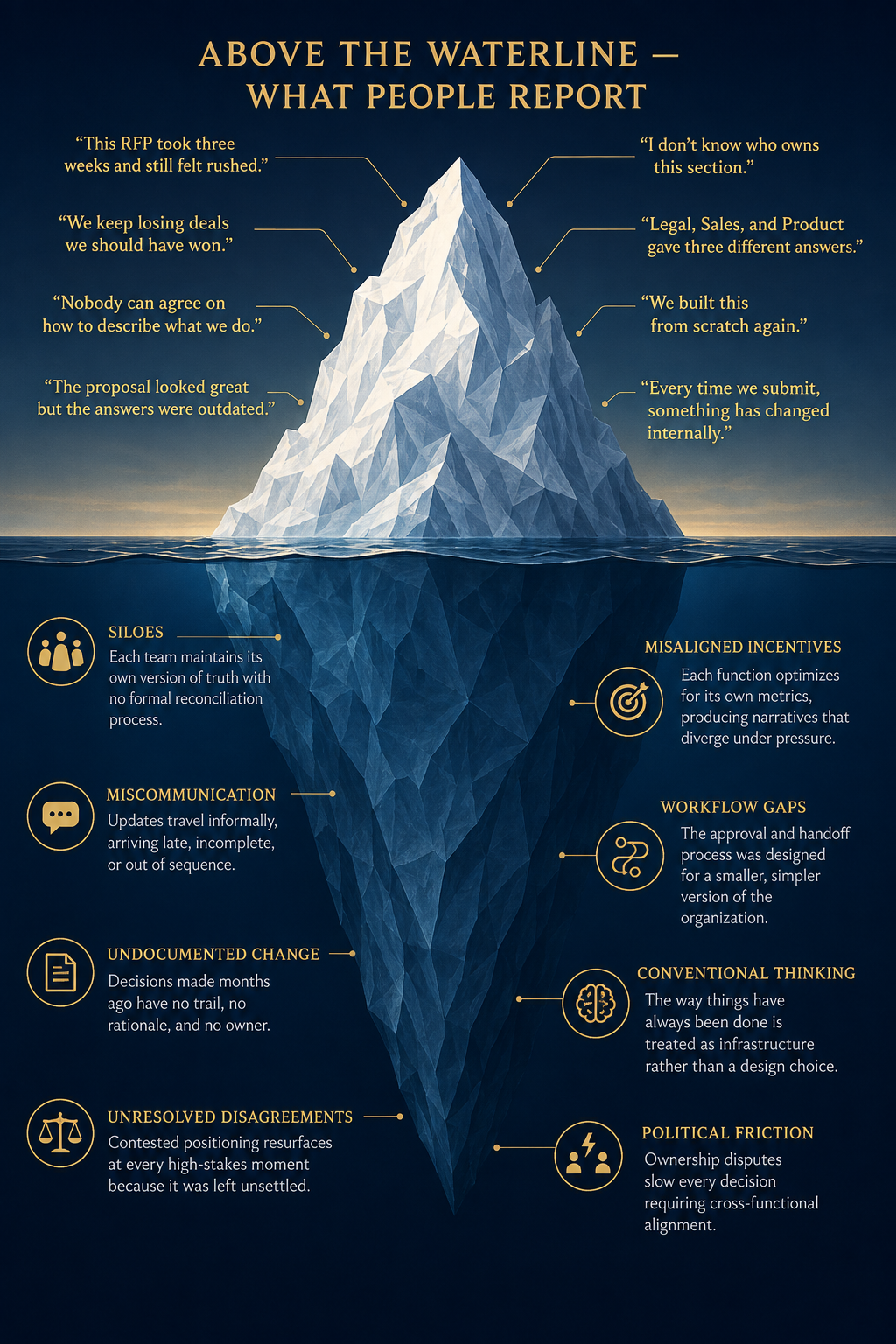
What the Proposal Process Actually Reveals
Visible complaints are the surface.
Structural design failures are the cause.
The friction people voice about proposal difficulty is real, but it points to a structural mass beneath the waterline that no tool resolves on its own.
Above the waterline — what people report
"This RFP took three weeks and still felt rushed."
"We keep losing deals we should have won."
"Nobody can agree on how to describe what we do."
"The proposal looked great but the answers were outdated."
"I don't know who owns this section."
"Legal, Sales, and Product gave three different answers."
"We built this from scratch again."
"Every time we submit, something has changed internally."
Below the waterline — structural causes
Siloes
Each team maintains its own version of truth with no formal reconciliation process.
Miscommunication
Updates travel informally, arriving late, incomplete, or out of sequence.
Undocumented change
Decisions made months ago have no trail, no rationale, and no owner.
Unresolved disagreements
Contested positioning resurfaces at every high-stakes moment because it was left unsettled.
Misaligned incentives
Each function optimizes for its own metrics, producing narratives that diverge under pressure.
Workflow gaps
The approval and handoff process was designed for a smaller, simpler version of the organization.
Conventional thinking
The way things have always been done is treated as infrastructure rather than a design choice.
Political friction
Ownership disputes slow every decision requiring cross-functional alignment.
The real issue
The proposal is a visible symptom. A document is slow, inconsistent, and contested because the organization beneath it was never designed to produce coherent, durable knowledge at scale. The fix requires sharper leadership accountability, more deliberate execution design, and a strategy people across the organization can describe in the same words.
Where the Paths Intersect
Inventive AI operates at the output layer.
Reason Reveal operates at the structural layer beneath it.
Reason Reveal diagnoses how roles, rules, workflows, and processes impede how people and technology perform. That friction fractures internal narratives before they ever reach the proposal desk or the client.
Inventive AI
- Proposal assembly
- RFP drafting at speed
- Multi-source synthesis
- Consistent outputs
Shared
- Org readiness
- Source clarity
- Win rate lift
- Retention
Reason Reveal
- Org diagnosis
- Role clarity
- Process redesign
- Structural alignment
The referral lives in the overlap
Inventive AI needs
Clean, authoritative source material to generate high-quality outputs.
Reason Reveal delivers
Organizational readiness: teams structurally aligned and operationally clear before any tool is introduced.
When Inventive AI Should Refer to Reason Reveal
Four signals in a sales cycle or client engagement that indicate a structural diagnosis is needed.
Inventive AI's product is exceptional. It relies on one critical assumption: the organization's internal knowledge is coherent. When it is not, these signals appear.
Pre-sale friction
A prospect is interested in Inventive AI but struggling to get their documentation, ownership, or internal narrative in order before onboarding.
Referral action
Refer for an organizational readiness diagnostic before implementation begins. This protects the sales cycle and sets the client up for faster time to value.
Low adoption after implementation
The tool is deployed but not used effectively. Departments describe the company, product, or value proposition differently. Source material trust is low.
Referral action
Refer for a narrative alignment engagement. The issue is structural. Resolving it releases the ROI the client expected from Inventive AI.
Implementation stall
A prospect keeps delaying the start date, citing internal cleanup they need to do first. They are in an organizational readiness gap.
Referral action
Refer to accelerate that cleanup. Once they reach organizational readiness, they return as a higher-quality, higher-retention client.
Escalating internal conflict
During onboarding, it becomes clear Sales, Product, and Leadership have materially different versions of the company story. The conflict appears inside the tool's outputs.
Referral action
Refer immediately. This is a structural alignment problem that will consume the implementation team if left unaddressed.
Why Referring Improves Inventive AI Retention
A tool deployed into organizational dysfunction will underperform regardless of its quality.
When clients churn or fail to renew, the stated reason is often the product. The root cause is almost always the organization. Referring to Reason Reveal before or during implementation addresses that root cause directly.
1
Higher-quality onboarding
Clients arriving from a structural alignment engagement have clean documentation, clear ownership, and a shared internal narrative. Inventive AI onboards faster, encounters fewer revision cycles, and produces measurable outputs sooner.
2
Reduced support burden
Most support escalations in B2B software trace back to stakeholder misalignment. When clients are organizationally ready, the volume of internal disputes reaching the support channel drops significantly.
3
Stronger ROI evidence
When the organizational substrate is clean, Inventive AI outputs are demonstrably better. Building the business case for renewal, expansion, and internal advocacy becomes straightforward.
4
Clients who stay longer
Organizationally mature clients expand because they have the capacity to absorb and act on what the tool produces. The referral creates a better class of long-term customer.
5
A shared proof of concept
Every mutual client who succeeds with both services becomes a case study for both. The arc from organizational diagnosis to proposal excellence is a compelling, repeatable story for both practices.
When Reason Reveal Refers to Inventive AI
Once organizational alignment is achieved, clients need tools to operationalize it at scale.
This is where Inventive AI becomes the natural next step in the client relationship.
Post-diagnostic alignment achieved
A client has completed a structural alignment engagement and now has clean, authoritative internal documentation. They are ready to use proposal intelligence tools to scale clarity externally.
Sales team fragmentation resolved
A client's sales narrative has been unified across Product, Engineering, and GTM. They now need a tool to operationalize that narrative in their proposal process at speed.
PE-backed company approaching exit
A portfolio company is preparing for exit and needs to present a clean, consistent operational narrative to buyers. Proposal-quality documentation is a competitive advantage in that process.
The Shared Ideal Client Profile
Both practices serve organizations operating under complexity and performance pressure.
The overlap is the referral sweet spot.
Shared — both practices serve this client
PE-backed, $250M to $2B revenue
Investor-accountable with formal value-creation mandates.
Large, complex cost base
Labor, technology, vendor, and product and engineering spend at scale.
Multi-function complexity
Multiple business units, systems, geographies, or significant cross-functional dependencies.
Value-creation pressure
Margin expansion, professionalization, or operational transformation in the VCP.
Selling complex products or services
Win rates are directly tied to narrative consistency and internal alignment.
Early-to-middle hold period
Enough runway remaining to capture compounding improvements.
Unique to Inventive AI
- ›Active RFP volume: teams regularly responding to tenders or proposals
- ›Multi-source documentation requiring synthesis at speed
- ›Sales teams where proposal quality directly drives close rate
Unique to Reason Reveal
- ›Finding potential: 2 to 5% systemic inefficiency plausibly generating $10M or more in recurring annual exposure
- ›Technology modernization, integration, or product acceleration in the VCP
- ›Execution drag visible to the board or sponsor, not just felt internally